

Designing energy policy in a way to keep the balance between energy costs, security of supply and decarbonisation is crucial for the EU, whose energy import dependency is still around 60%, at times of risks to supply shortages and fluctuating oil and gas prices. In this context, it is reasonable that European countries seek to reduce fuel import dependency through both energy savings and faster deployment of green energy. Several EU-wide analyses have shown that avoided fossil fuel imports due to decarbonisation will generate net welfare gains in Europe.
Most of the immediate policy-related analyses focus only on the direct impacts of our energy dependency, i.e. the effect of higher fossil fuel prices on the EU’s import bill. The European Commission estimated the EU fuel import bill to have reached 2.2–3.4% of EU’s GDP in the years since 20221. The European Commission’s President stated on 13 April 2026 that since the beginning of the Iran conflict, EU’s bill for fossil fuel imports has increased by over 22 billion Euros2. The fuel import bill provides a clear picture of the direct impacts; in addition, we must consider how these costs diffuse in the entire economy and to what extent they crowd out investments or expenditures in other economic sectors, as we must also account for the costs of imports of renewable energy equipment in Europe.
To address this challenge, a detailed analysis for the Republic of Cyprus, which does not possess indigenous fossil fuels, depends on oil imports for over 70% of power generation but also imports all major renewable energy equipment, was conducted by the ACCREU partner Theodoros Zachariadis, and by Elias Giannakis. The analysis relied on official energy, economic and trade data from the last decade to examine the direct impact of renewable energy deployment that led to partial independence from fuel imports. The authors applied input-output modelling to explore how the costs and benefits of decarbonisation have spread in the economy and assessed the impacts on growth and employment by sector (see Figure 1). They found that already today, renewables deployed in Cyprus over the past decade have contributed to the accumulation of net benefits of 469 million Euros at 2023 prices. Benefits will continue to accrue in the coming years and reach almost 3 billion Euros by 2023, up to 2035. If the avoided costs from air pollution are accounted for, net benefits exceed 5 billion Euros in 2023, leading to a benefit-cost ratio ranging between 11.4 and 19.2: for every Euro spent on renewables in Cyprus, the economy gains at least 11 Euros in benefits. Economy-wide benefits are even stronger: Renewables deployment and avoided fossil fuel imports led to a 0.5-1% GDP increase per year, creating almost 30,000 new jobs.
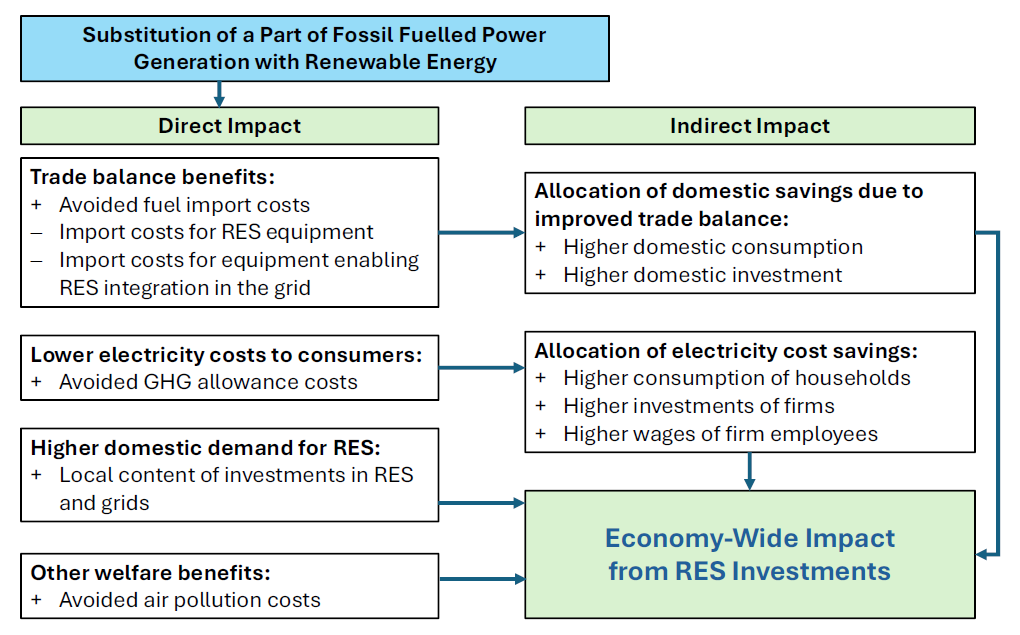
Figure 1: Outline of the methodology to assess the economy-wide impact of renewable energy deployment in Cyprus. “+” denotes a positive economic impact while “–” a negative impact.
The European Central Bank has recently underlined that green energy strengthens macroeconomic stability and supports economic growth and Europe’s strategic autonomy3. The analysis confirms these findings and, if applied at the same level of detail to all European countries, can offer credible country-specific insights on the economy-wide impact of strengthening national energy security through decarbonisation policies.
Full report: Improving Energy Security Through Decarbonisation: The Economy-Wide Benefits of Renewable Energy Deployment
__________________________________________
- Figure 1: Outline of the methodology to assess the economy-wide impact of renewable energy deployment in Cyprus. “+” denotes a positive economic impact while “–” a negative impact. ↩︎
- Statement by European Commission President von der Leyen on the impact of the situation in the Middle East on the European Union, 13 April 2026. ↩︎
- Blog post of Frank Elderson, Member of the Executive Board of the ECB, 7 April 2026. ↩︎