
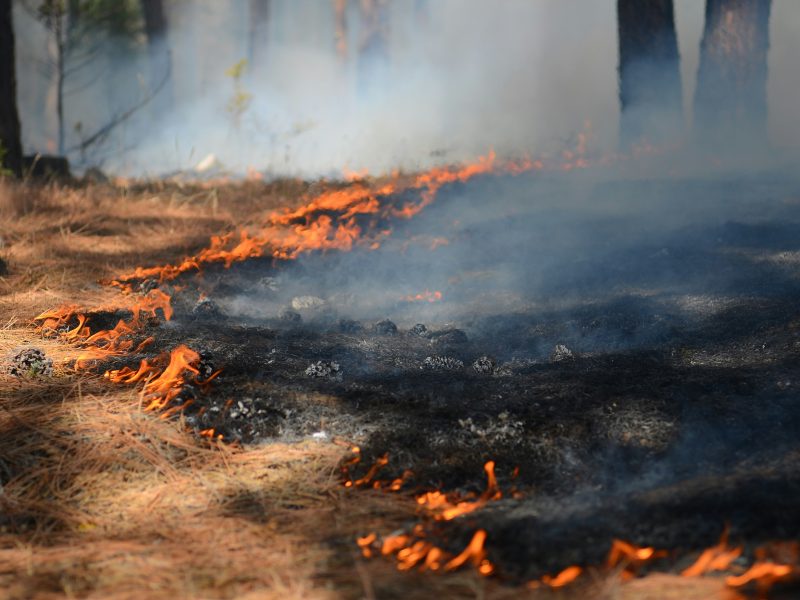
Forest fires are currently raging in the south, and there are several factors that are further fuelling them. Ophélie Meuriot, Jorge Soto Martin, Francisco Pereira and Martin Drews have investigated how meteorological, climatological, natural and human factors – including terrain and land use – influence the risk of wildfires in southern Europe and the Mediterranean – both now and in the future. The study forms part of ACCREU research into wildfires and climate; when they occur; how they spread; and their consequences for people, nature and society.
To investigate the significance of over 20 different potential risk factors, we trained a machine learning model that helped us identify the most important factors and determine their relative importance, based both on observations and on calculations using a regional climate model. Our research shows that:
▪️ It is necessary to take into account meteorological, climatological, natural and human factors when determining the local risk of forest fires.
▪️ Variations on both very short timescales (days) and very long timescales, such as drought, play a significant role
▪️ In a warmer climate, the risk of wildfires will increase if human and natural factors, including land use, remain unchanged
▪️ Changes in human factors and land cover, such as reforestation, can either help to reduce or increase the risk – and further consequences – of wildfires. This means that area-based climate adaptation may be absolutely necessary if we are to counteract the consequences of a longer wildfire season and a generally warmer and drier climate in southern Europe.
Future wildfire risk in Southern Europe under changing land use, population, and climate: a data-driven approach
by Ophélie Meuriot, Jorge Soto Martin, Francisco Camara Pereira and Martin Drews