Over the past year, the ACCREU project has directly contributed to a flagship international climate publication – the United Nations Environment Programme Adaptation Gap Report (AGR) of 2024.
ACCREU has contributed to the Chapter on the adaptation finance gap, which is defined as the difference between the estimated costs of meeting a given adaptation target and the amount of finance available for adaptation (United Nations Environment Programme [UNEP] 2014).
In practice, estimating this gap is challenging, both conceptually and quantitatively (UNEP 2016; UNEP 2023a). Furthermore, while a monetary metric helps communicate the scale and urgency of the gap, finance is a means rather than an end, and does not guarantee efficient and effective
adaptation (see chapter 3). Nevertheless, a widening adaptation finance gap indicates a deepening climate crisis and will mean higher losses and damages.
Chapter 4 of the AGR 2023 and the supporting Adaptation Finance Gap (AFG) Update (UNEP 2023b) undertook a new and comprehensive analysis to estimate the costs of adaptation and the adaptation finance needs for developing countries. This value is highly relevant for discussions on the new collective quantified goal (NCQG) for climate finance,3 which is to be established before 2025. The AGR 2024 has not updated these values, but it does include discussion on new information.
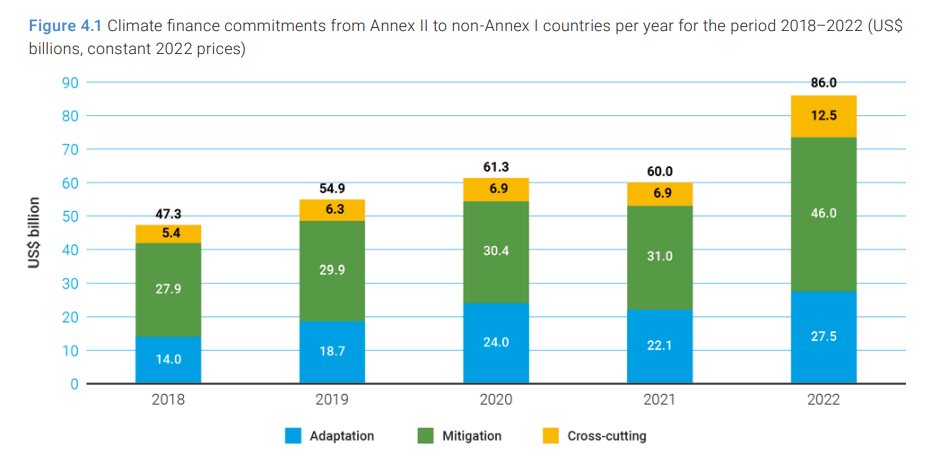
The AGR 2024 has updated the analysis of adaptation finance flows using the latest data available. This provides insights on the progress towards the Glasgow Climate Pact, which urged developed country Parties to at least double their collective provision of climate finance for adaptation to developing country Parties from 2019 levels by 2025.
Finally, the AGR 2024 has undertaken a more in-depth analysis of the nature of the adaptation finance gap and discusses initiatives that might help close the gap.