
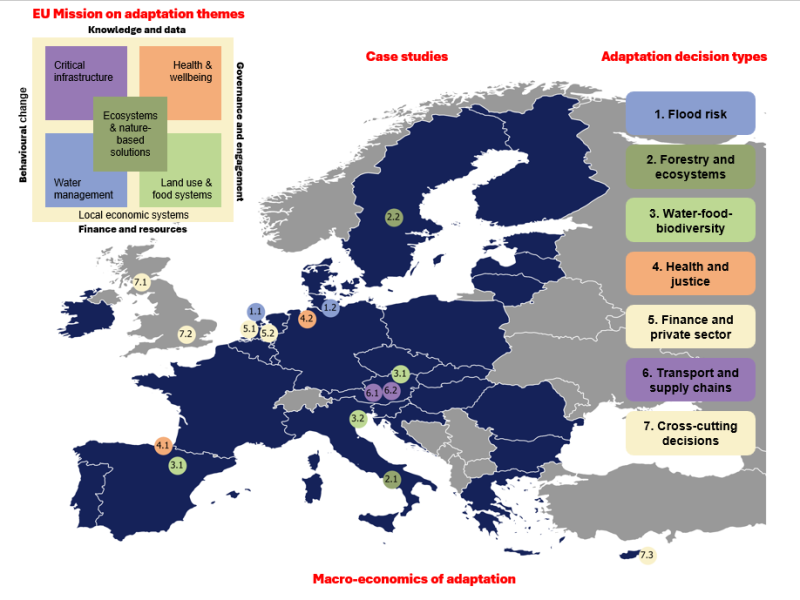
In a recent ACCREU deliverable, we report on the results of 15 co-produced climate adaptation case studies from across Europe. The fifteen case studies span seven adaptation decision types: flood risk, forestry & ecosystems, water-food-biodiversity nexus, health & justice, financial sector, transport & supply chains, and cross-cutting national programs.
The case studies employed diverse methodological approaches; cost-benefit analysis, integrated assessment models (GLOBIOM, CWatM), flood and species distribution models, social justice assessments, and stakeholder interviews, demonstrating that comprehensive economic appraisal extends beyond traditional cost-benefit analysis to systematically address co-benefits, distributional impacts, barriers, path-dependencies, and flexibility under deep uncertainty.
Common findings emerged across the case study contexts. Perhaps most surprisingly, technological constraints were not the primary barriers to adaptation. While technical and physical challenges were identified in approximately half the cases (47%, 7/15), they rank only fifth among barrier types. This finding contradicts the often-held perception that adaptation is primarily limited by technological readiness or physical constraints. Instead, institutional and governance barriers emerge as the dominant constraint, present in all 15 case studies (100%). These include for instance fragmented responsibilities, weak inter-agency coordination, and lack of political support. Financial barriers follow closely as the second-ranking constraint at 93% (14/15 cases), encompassing high upfront costs of adaptation measures, limited capital availability, lack of long-term funding mechanisms, and financing structures that favour incremental over transformative approaches.
A critical paradox emerges from the findings: most economic analyses demonstrate that the benefits of adaptation substantially outweigh the costs, yet implementation remains constrained primarily by financial and institutional barriers. While available economic analyses consistently show favourable adaptation economics, incomplete quantification of benefits, especially co-benefits, undermines political acceptability and policymaker confidence. This evidence gap disproportionately affects transformative adaptation and green/soft measures, as incremental grey infrastructure can often rely on established cost-estimation methods and familiar risk-reduction metrics. To advance adaptation beyond incremental grey infrastructure towards more transformative, integrated, and nature-based approaches, a comprehensive economic analysis is a necessity.
This ACCREU deliverable sought to contribute to this gap, as the economic appraisal in ACCREU focused on comprehensive appraisal, to include not only traditional cost-benefit analysis but also co-benefits, co-costs, distributional impacts, and path-dependencies.
However, implementation of the framework also identified some structural methodological challenges:
- Quantification gaps: Monetizing co-benefits (ecosystem services, biodiversity, social justice outcomes) remains difficult, limiting their influence on decision-making despite their recognized importance.
- Strategy-level appraisal: Most case studies focused on individual adaptation options rather than integrated strategies, reflecting the complexity of assessing option portfolios and their interactions.
- Distributional analysis: Only a limited number of cases assessed equity impacts across social groups, constrained by data availability and methodological limitations.
These challenges contribute directly to the adaptation paradox described above, as incomplete quantification undermines the full economic case for adaptation and thus implementation even when partial analyses are positive.
Regardless of these challenges, the ACCREU case studies have also directly informed adaptation policy and practice. The UK case studies (CS7.1/7.2) provided adaptation cost data to HM Treasury for spending reviews, the Office of Budget Responsibility for fiscal risk assessments, and the Climate Change Committee for the Climate Change Risk Assessment. In Cyprus (CS7.3), the first comprehensive national adaptation cost assessment supported Cabinet adoption of the revised National Adaptation Strategy. In Italy (CS3.2), research on climate impacts in the Venice lagoon will support protected area management strategy development. In Germany, the Baltic Sea coast case study (1.2), is helping stakeholders consider green adaptation measures, and the Bremen case (CS4.2) helped stakeholders in identifying social justice criteria for adaptation monitoring.
Furthermore, the case studies also provide transferable insights and methodological approaches applicable to similar contexts across Europe and beyond. The demonstrated flexibility of the ACCREU framework, successfully applied from local conservation projects to national strategies, suggests its utility for adaptation assessment across diverse decision contexts, governance levels, and sectoral applications.
Related deliverable:
ACCREU Deliverable D3.2 “Adaptation case study analysis”
by Anoek van Tilburg, Maaike van Aalst, Kees van Ginkel, Ad Jeuken