
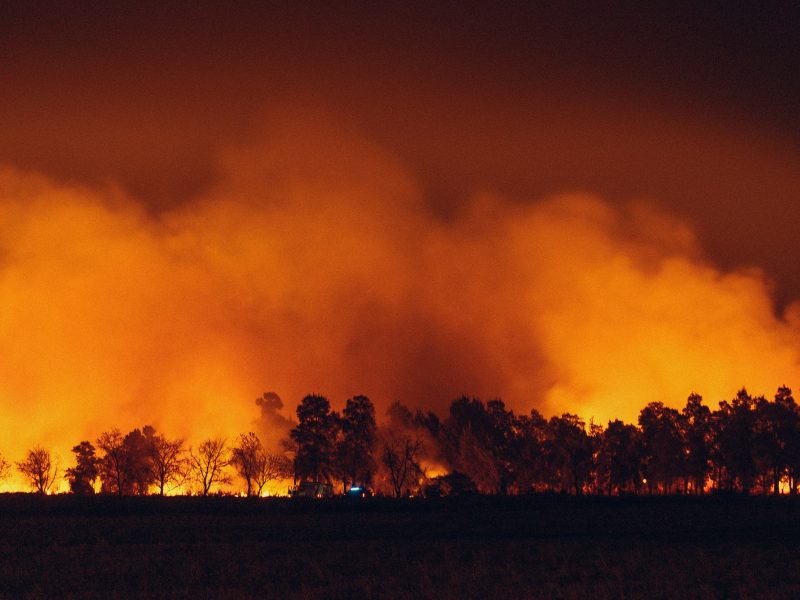
Wildfires constitute some of the most devastating natural disasters, with impacts across economic sectors, society and environment in Europe and globally that are increasing. Within ACCREU, we have developed a novel framework for modeling the impacts and adaptation of wildfires that combines a data-driven model of present and future wildfire risk, regional climate simulations downscaling results from the CMIP6 global climate model ensemble, and a state-of-the-art wildfire spread model (ForeFire).
Machine Learning (ML) has previously been shown to be effective in quantifying wildfire risk using diverse data sources such as weather and climate data, land cover, and human factors under current climate conditions. How future wildfire risk will evolve under different climate scenarios is less certain, as this depends not only on the magnitude of future emission trajectories and subsequent climate warming but also on land use.
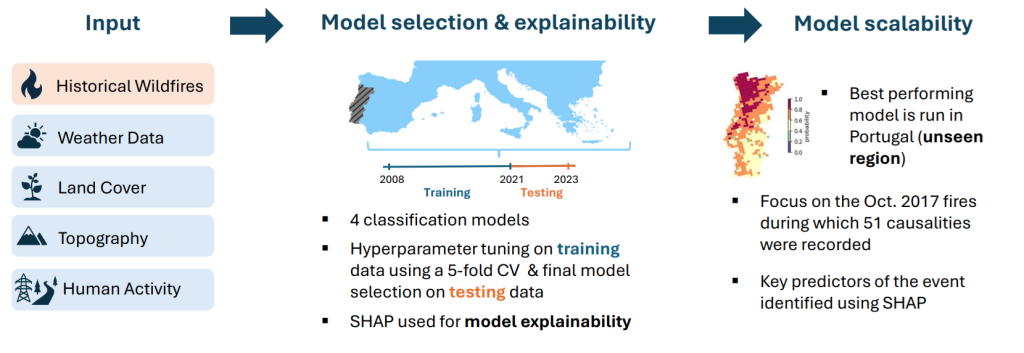
In early December 2025, Dr. Ophélie Meuriot will present ACCREU results on the use of ML for wildfire risk modeling obtained by the DTU team at several leading AI conferences. On 2nd and 6th December 2025, Dr. Meuriot will present at two international events taking place in Copenhagen: the ELLIS UnConference Workshop – AI for Earth and Climate Sciences and the EurIPS 2025 conference – as part of the AICC: Workshop on AI for Climate and Conservation.
Finally, on 7th December 2025, Dr. Meuriot and ACCREU will contribute a Spotlight talk at one of the most prestigious AI conferences in the world with a focus on climate: NeurIPS 2025 – the Thirty-Ninth Annual Conference on Neural Information Processing Systems. Here, Dr. Meuriot will present recent results from a conference paper on “Scalable & explainable ML for wildfire risk modeling in Southern Europe: A case-study in Portugal”.
Related publication:
Scalable & explainable ML for wildfire risk modeling in Southern Europe: A case-study in Portugal
by Ophélie Meuriot, Jorge Soto Martin, Beichen Zhang, Francisco Camara Pereira and Martin Drews