

The ACCREU project deliverable “Advancing impacts and adaptation in IAM and CGE models” marks a milestone in improving the linkage between detailed sectoral results on climate impacts (work package 2) and aggregate macroeconomic models (work package 4). Compared to previous projects focusing on climate impacts, ACCREU’s detailed focus on adaptation scenarios, effectiveness and costs makes these linkages considerably more complex and more challenging to build consistently. The process provides the foundation for a variety of upcoming applications, including aggregate macroeconomic damages, an integrated assessment of the interplay between adaptation and mitigation across a variety of sectors and under different climate policy pathways, as well as distributional and macrofinancial implications. At the same time, the process and lessons learned from it as described in this deliverable provide a valuable resource for future projects aiming at such an integration.
Developing a common understanding of adaptation
ACCREU strives to integrate detailed process-based assessments of climate impacts and adaptation options across the areas agriculture, coastal infrastructure, riverine floods, energy, health, labor and biodiversity into macroeconomic assessments. This requires (1) an alignment of the model assumptions in terms of climate and socioeconomic scenarios and adaptation levels; and (2) an in-depth understanding of the considered adaptation options for a meaningful integration of the results into the macroeconomic models.The Deliverable describes the scenario protocol used and how models interpreted in particular the three required levels of adaptation (low, medium, high) across the dimensions trade, technology and adaptive capacity. Not all models can cover all of these areas. Process-based models naturally have more entry points for variations in these domains than empirically based approaches. An example are the protection targets for dike height in the coastal infrastructure model DIVA or the expansion of irrigated areas in the agroeconomic model GLOBIOM.
Beyond this level of specification a detailed exchange process between modeling teams was required to understand how exactly models interpret and implement given adaptation options given their general modelling approach. Key questions to be answered include the type of adaptation (e.g. infrastructural or nature-based), the way of implementation (e.g. upfront investments or continuous upgrades or shifts in production), the objective of the adaptation measure or who bears the costs.
Linkages
The sector-specific data are either taken up directly in the macroeconomic models with sectoral resolutions (ICES, COIN-INT), or they are combined into aggregated damage and adaptation cost functions to be used in the more aggregate integrated assessment models REMIND and MIMOSA. The IAM WITCH uses a combination of both approaches, demonstrating in the deliverable the expansion of its sectoral impact representation.
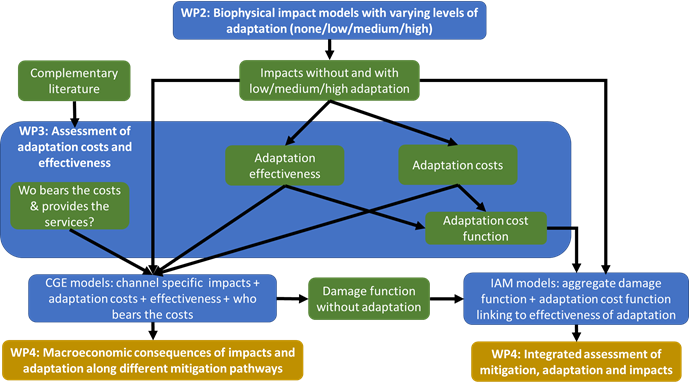
Figure 1: Data and information flow from sectoral level assessment of climate impacts and adaptation to macroeconomic modeling.
Key challenges
This deliverable, together with ACCREU Deliverable 3.4 on adaptation costs, demonstrate tremendous progress in a bottom-up assessment of adaptation costs and effectiveness in a range of sectors. The wide range of different approaches across impact models poses a great challenge her which goes beyond a mere alignment of scenarios and units into a deeper understanding of core assumptions made in each model. This can range from the modeling of investment strategies to the meaning of variables. It remains challenging to really quantify the costs of adaptation given that the models only represent a limited range of available options.
Related deliverable:
ACCREU Deliverable D4.1 “Advancing impacts and adaptation in IAM and CGE models“
by Franziska Piontek (PIK), Birgit Bednar-Friedl, Nina Knittel, Eva Preinfalk, Alexandra Lehner (Uni Graz), Jan Brusselaers, Michiel Ingels, Max Tesselaar (VU), Stefano Battiston, Michelangelo Puliga (University of Venice), Matthias van der Heyden, Kaj-Ivar van der Wijst, Andries Hof (UU), Laurent Drouet, Enrica De Cian, Francesco Bosello, Gabriele Alessandro Mansi, Francesco Colleli, Lorenza Campagnolo (CMCC)