
Sea-levels are rising and coastal flood risks are increasing. Flood risk management aims to reduce these risks. Usually, for investments in flood risk management we tend to only look at the costs and benefits during the life cycle of a measure. But what happens beyond that?
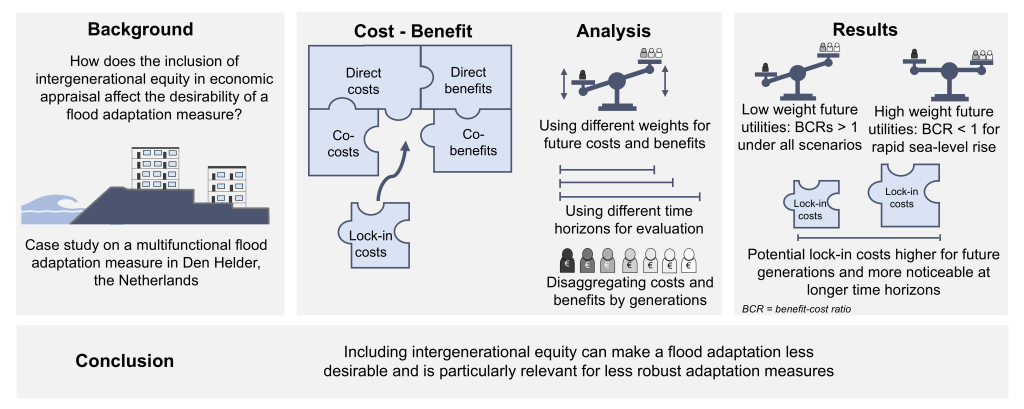
A new study by Deltares and Vrije Universiteit Amsterdam, shows that considering what happens beyond the life time of measures could change outcomes of economic appraisals. This paper is based on one of the ACCREU case studies reported on in Deliverable 3.2: a climate dike (or superdike) in Den Helder, the Netherlands.
As many flood mitigation measures have long life times, the costs of removal and adjustment tend to fall on future generations. To account for this, the paper present a novel approach for quantifying the costs of switching adaptation measures at the point it stops working or becomes undesirable.
With modest sea-level rise, the climate dike is a good solution: it will have more benefits than incremental dike reinforcement, as a result of increased spatial quality and additional income from more new housing. However, beyond the capacity of the climate dike, the switching costs can be considerable.
Besides switching costs, the wellbeing of future generations was also accounted for by showing the economic outcomes per generation, using multiple discounting principles, and using long time horizons. The study shows that economic evaluations should look beyond just short-term effects. Explicitly accounting for switching costs and generation-specific effects makes evaluations more transparent and provides a more realistic picture of the consequences of different choices.
The full paper is available here: https://doi.org/10.1016/j.crm.2026.100886