
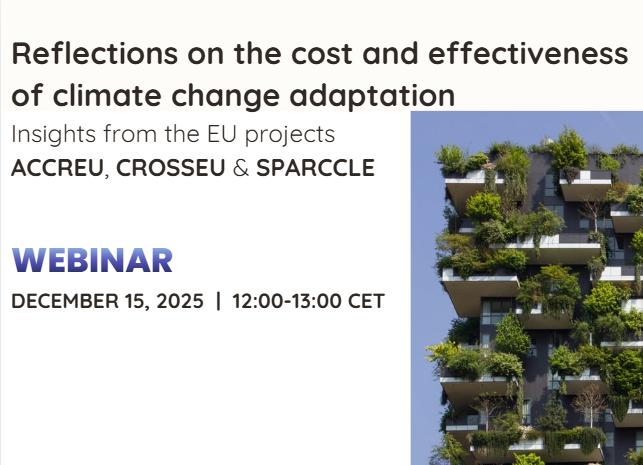
As a part of the ACCREU research project, a joint webinar series together with the sister projects CROSSEU and SPARCCLE was organised.
The first webinar on the topic “Reflections on the cost and effectiveness of climate change adaptation” was held on Monday 15 December 2025, offering an advanced, interdisciplinary overview of the links between climate risk, socioeconomic inequality, and adaptation strategies, and providing essential insights for developing resilient and inclusive climate policies in Europe.
INVITED PANELISTS

Understanding climate risk and pathways to resilience in Europe: concepts and first results from SPARCCLE
Rosanne Martyr and Ann-Kathrin Petersen, Climate Analytics, SPARCCLE Project
SPARCCLE supports an enhanced climate risk assessment for Europe by integrating new probabilistic emulators of climate hazards and granular socioeconomic projections which provide insight into multidimensional vulnerabilities, including gender and socioeconomic heterogeneities. Further, the reduction of future risks through climate adaptation will be considered by the development of sector-specific adaptation pathways. Adaptation pathways are an approach which can inform climate adaptation planning and decision-making about adaptation options and sequences which are robust in a variety of future scenarios. The identification, assessment, and integration of adaptation options and pathways are a key input into the probabilistic climate risk modelling with CLIMADA. Future climate risk will be assessed using the numerical damage assessment model CLIMADA. The probabilistic risk estimates from CLIMADA will further be coupled with CATSIM and IAMs.
Climate Shocks and Income Inequality: Some first results
Nicholas Vasilakos, Norwich Business School, CROSSEU Project
This paper provides global, micro-disaggregated evidence on the relationship between extreme climate events affect income inequality. Combining percentile-level household income data from the World Bank’s Poverty and Inequality Platform with high-resolution ERA5 climate indicators, we examine the heterogeneous effects of heatwaves, coldwaves, droughts, and extreme precipitation on income distribution across more than 140 countries. Using Recentered Influence Function regressions, we estimate unconditional impacts at different points of the income spectrum and on inequality indices. Results reveal that extreme climate events are markedly regressive: heatwaves, coldwaves, and droughts significantly reduce lower-tail incomes while leaving upper-tail incomes largely unaffected or even improved, leading to higher Gini coefficients and wider 90/10 income gaps. Droughts are uniquely persistent in their effects, while heavy rainfall shocks display non-linear, inequality-widening dynamics at higher intensities. The analysis further shows that agricultural dependence and climate zone moderate these outcomes – inequality rises most in arid and temperate regions, while tropical and transitional climates exhibit partial resilience. These findings highlight that climate change operates not only as a productivity shock but also as a distributional one. Designing climate adaptation and fiscal policies that explicitly address inequality is therefore essential to prevent climate extremes from reversing gains in poverty reduction and inclusive development.
ACCREU Results on the Costs and Benefits of Adaptation in Europe
Paul Watkiss, Paul Watkiss Associates, ACCREU Project
The ACCREU project has generated a set of new results on the economic costs of climate change in Europe, and the costs and benefits of adaptation, using a suite of sector assessment models. This session will present these new EU values, reporting how cost-effective adaptation could be in helping to reduce European climate impacts. The ACCREU study has also used the global data from these models to derive new global estimates of adaptation costs and a new set of functional relationships for use in integrated assessment models, and these will be presented.
MODERATOR
Francesco Bosello, Ca’ Foscari University of Venice and Euro-Mediterranean Centre on Climate Change, ACCREU Project Co-ordinator
WATCH THE WEBINAR RECORDINGS
ACCREU webinar on YouTube
PRESENTATIONS