

The ACCREU project developed a structured co-creation framework to strengthen the link between climate risk research and practical decision-making across Europe. Through continuous collaboration with policymakers, businesses, civil society organisations, and researchers, the project aimed to ensure that scientific outputs were directly aligned with real adaptation and resilience needs.
The project was organised around three interconnected phases: co-design, co-production, and co-delivery. Initial activities focused on a stock-take of the current state-of-knowledge and research gaps, identifying stakeholder priorities on which of these were most important, and translating these into actionable research questions. This process generated a broad portfolio of adaptation-related challenges covering the economic costs of climate change, adaptation costs and benefits, as well as governance, finance, and equity.
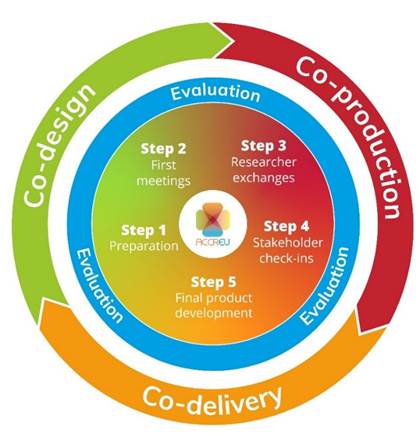
A central component of the project was the implementation of multiple adaptation case studies. These were framed around a set of Adaptation Decision Types (ADTs), addressing themes such as coastal and river flood protection, , water management, heat-health adaptation, financial systems, and supply chain resilience. Fifteen case studies were undertaken in collaboration with stakeholders, who contributed directly to the development, testing, and validation of project outputs.
Particular emphasis was placed on the co-delivery phase, to translate the knowledge generated into practical uptake and policy application. This process interacted with stakeholders to refine policy messages and support the uptake of research findings into ongoing planning and governance processes. The project organised targeted dissemination activities, including participation in external policy and sectoral events, bilateral meetings with decision-makers, and thematic workshops linked to the Adaptation Decision Types (ADTs). These activities helped ensure that findings were communicated in formats directly aligned with stakeholder needs and institutional contexts.
This generated measurable policy impacts across several countries and sectors. In the United Kingdom, the project findings contributed to national government spending reviews and were used in the 4th climate change risk assessment and well-adapted UK report by the Climate Change Committee. In Cyprus, ACCREU provided the country’s first comprehensive adaptation cost assessment for the revised National Adaptation Strategy . In the Netherlands, research informed water management planning and climate-finance discussions with the Dutch Central Bank and insurance sector stakeholders.
Beyond direct policy integration, the co-delivery activities also supported broader “perspective shifts” among stakeholders. Examples included the case for nature-based solutions in German coastal planning, integrating social justice considerations into adaptation monitoring in Bremen, and strengthening climate-risk awareness in ecosystem management and private-sector decision-making. In several case studies, stakeholders highlighted that the collaborative dissemination process helped transform research findings into actionable guidance and practical decision-support tools.
The overall participatory co-creation approach was reflected in the project impact. More than 1,200 stakeholders were engaged through workshops, consultations, technical meetings, and dissemination events.
The final stakeholder workshop in Brussels in April 2026 represented a key milestone of the co-delivery phase. The workshop presented consolidated findings from sectoral, macroeconomic, and adaptation case-study research streams and gathered stakeholder feedback on final dissemination products and policy priorities. Participants contributed directly to shaping the project’s final policy messages, identifying remaining research gaps, and refining the usability of digital knowledge products.
An important outcome of the co-delivery process was the emphasis on producing concise, user-oriented outputs capable of supporting evidence-based adaptation planning across governance levels. Stakeholders requested synthesis-oriented communication products, integrated information hubs, and clearer transparency regarding methodologies and assumptions. These recommendations are being integrated into the final dissemination strategy and will inform the project’s concluding policy briefs and synthesis reports.
Overall, the ACCREU project demonstrated that effective climate impacts and adaptation research requires not only robust scientific analysis, but also sustained collaboration with end users throughout dissemination and implementation. The co-delivery phase played a critical role in bridging the gap between research and practice, ensuring that project results could support concrete adaptation planning, policy development, financial decision-making, and long-term resilience strategies across Europe.sponses than temperate and boreal forests, yet fire-sensitive taxa declined severely even there. However, only 13 of Europe’s forest ecoregions were represented, and biome-level patterns often arose from a single nested ecoregion, limiting spatial generalizability. Substantial residual heterogeneity indicates that unmeasured factors play significant roles, and critical data gaps, especially absent prescribed fire data for fire-sensitive taxa and limited long-term monitoring, constrain management guidance.
These findings reveal ecological trade-offs: fire regimes benefiting fire-opportunistic taxa cause severe declines in fire-sensitive taxa. As climate change drives novel fire regimes across Europe, evidence-based fire management requires strategies that incorporate spatial heterogeneity, conserve refugia, and explicitly consider taxonomic trade-offs. Standardized, long-term monitoring across successional stages, fire events, and taxonomic groups is essential, along with consistent reporting of fire characteristics, functional traits, microhabitat complexity, and refugia availability. Combined with improved data sharing, such monitoring will enable adaptive management frameworks that balance wildfire risk reduction with biodiversity conservation in an era of unprecedented fire regime change.
ACCREU Report of strategic co-creation actions
by Paul Watkiss, Katriona McGlade, Jenny Tröltzsch