
The vulnerability of energy systems to climate change is an aspect that is recognised in the scientific literature, but is currently largely missing from long-term national planning. Projected impacts due to climate change include growth in electricity demand due to air conditioning adoption and increased space cooling needs, thermal power plant outages due to extreme heat and water droughts, and changes in renewable energy generation. These aspects are investigated in an analysis conducted by the Cyprus Institute and CMCC, where a technoeconomic model is used to compile climate impacts on demand and supply, and assess their effect on the generation mix and electricity supply costs.
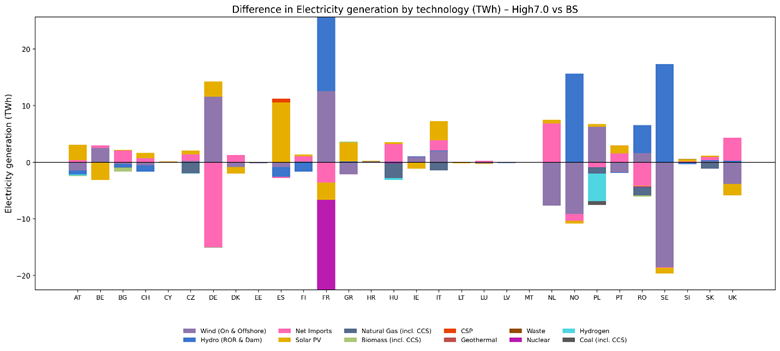
Figure 1. Difference in electricity generation by technology across countries in the High adaptation case for RCP7.0 as compared to a baseline scenario (BS) without climate impacts and adaptation.
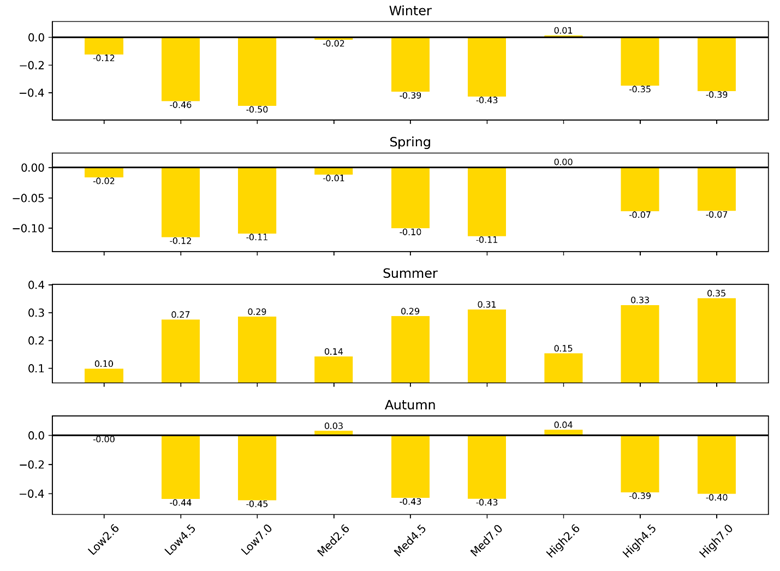
Figure 2. Absolute change in the EU electricity supply cost (EUR/MWh) across seasons, climate, and adaptation scenarios.
Based on the projected climate impacts across three Representative Concentration Pathways (RCP2.6, RCP4.5, RCP7.0) and three levels of adaptation for air conditioning adoption and electricity load projections (low, medium, high), relevant climatic impacts on the European electricity supply system are analysed for a total of 9 future pathways. These alternative futures are compared against a baseline scenario, where no climatic impacts and no adaptation affecting electricity demand are introduced.
Scenario results distinctly indicate that the generation outlook of Europe’s energy systems will be affected by climate change. Impacts are observed in both demand and supply, clearly identifying the need for the incorporation of climate uncertainty in official energy planning efforts at the national and regional levels. Differences in demand are highly seasonal and are driven by changes in heating and cooling requirements. Changes in power plant availability and renewable energy generation output affect the choice of technology supplying electricity in nearly all represented countries. Even though no serious imbalances in energy supply and demand have been identified in the assessed scenarios, periods of extended pressure on the energy system, such as prolonged heat waves, may compromise grid stability and create the need for additional investments in generation, storage or grid infrastructure.
In terms of climate impacts on the cost of electricity supply, in regional terms, these are projected to be negligible. However, these vary seasonally, as small reductions are projected in the winter and equivalent increases in the summer. Similarly, smaller systems appear to be more vulnerable to supply and demand variations, which means policymakers and energy planners in relevant countries need to take climate projections into account when designing the future development of their respective systems.
Read the full deliverable
Climate change impacts in EU’s energy systems